Showing 601–660 of 18294 results
-
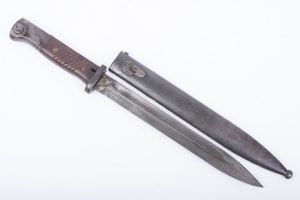
K98 bayonet marked crs 45
A very nice and late war K98 bayonet marked crs 45 indicating production by Paul Weyersberg & Co in 1945.
-
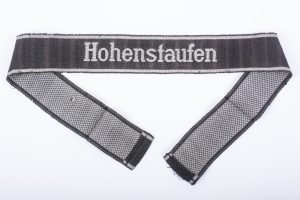
Textbook Waffen-SS BeVo 9. ᛋᛋ Panzerdivision Hohenstaufen cufftitle
A stunning original Hohenstaufen cuff title in very good uniform removed condition. The cuff title is still full length and retains the BeVo Wuppertal markings in the end. The 9. ᛋᛋ Panzerdivision Hohenstaufen saw heavy action in Normandy, Arnhem, the Bulge and finally surrendered to the Americans in Austria at the very end of the war. The cufftitle is a stunning example of a hard to find and highly sought after Waffen-SS that would be very hard to upgrade.
-
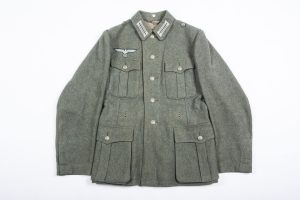
Minty M40 Heer tunic with factory sewn insignia
A stunning Heer M40 EM Feldbluse in near mint condition. The green Einheitslitzen are period factory sewn to the collar. The early breast eagle is period factory handsewn. The garment was most probably kept for walking out and has zero damages or alterations. The garment is made by Adolf Schuster Kleiderfabrik Neugersdorf. This is really a stunning and textbook EM M40 tunic in near mint condition that would be very hard to upgrade!
-
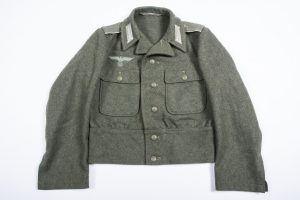
Mint condition Heer M44 field tunic
Superb original M44 field blouse for a Heer infantry EM. The tunic is mint, and retains all of its originally factory sewn insignia. The base material is a late war German wool and lined with grey rayon. The size is a medium fitting modern mannequins. The breast eagle is period factory sewn through the lining. The Litzen are also factory sewn, no traces of previously sewn examples. The tunic has not been shortened or tailored in any way. The tunic has multiple size markings; the usual sizes but also a additional stamp indicating the wearers height. The original factory red chalk markings for the buttons and holes are still visible. The tunic comes with a nice matching pair of late war EM shoulderstraps. More then likely this tunic was never ever worn! This is a superb and mint M44 field blouse, a typical garment as issued and worn by members of the Heer in the Wehrmacht. Every detail is textbook and finding a better example would be impossible!
-
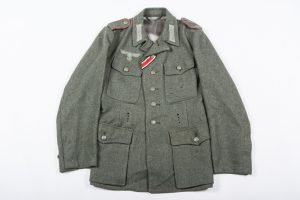
M42 Heer field blouse with factory sewn insignia
Stunning minty enlisted mens M42 field blouse with factory sewn insignia and a ribbon for the Eisernez Kreuz 2. Klasse. The blouse is in very good condition without moth damage. The blouse is maker marked Povel & Söhne. The breast pocket has a set of two wartime sewn medal loops. Interestingly the tunic has not 3 but 4 belt hook holes which seems to be a wearer modification. Hard to upgrade mint original M42 field blouse with factory sewn insignia and with a set of matching Artillerie EM shoulderstraps!
-
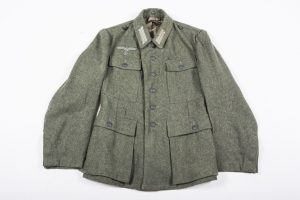
Mint condition Heer M43 field tunic
Superb original M43 field blouse for a Heer infantry EM. The tunic is mint, and retains all of its originally factory sewn insignia. The base material is a late war German wool and lined with grey rayon. The size is a small size fitting modern mannequins. The breast eagle is period factory sewn zig zag through the lining. The Litzen are also factory zig zag sewn, no traces of previously sewn examples. The tunic has not been shortened or tailored in any way. The tunic has multiple size markings; the usual sizes but also a additional stamp indicating the wearers height. The original factory red chalk markings for the buttons and holes are still visible. More then likely this tunic was never ever worn! This is a superb and mint M43 field blouse, a typical garment as issued and worn by members of the Heer in the Wehrmacht. Every detail is textbook and finding a better example would be impossible!
-
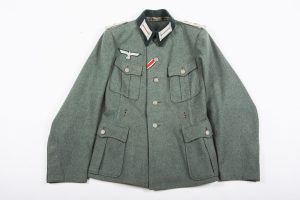
Stunning converted EM M34 field blouse for a Leutnant in 5./IR.111 Holland/Belgium/France
Stunning untouched Heer M34 tunic with full wartime sewn insignia for a Leutnant der Infanterie Regiment 111 – 35. Infanteriedivision. The garment is in very good condition retaining most if not all of the nap in the wool. The garment is a period converted EM tunic which most probably makes this a field tunic. The M34 model can be recognized with the open back and the the waist ties. The garment is nicely unit marked to Infanterie Regiment 111 inside the garment – matching with the shoulder boards. The garment is a perfect garment for a 1940 display sporting shoulder boards and markings for Infanterie Regiment 111 – a unit which fought hard in the 1940 campaign in the south of the Netherlands. Very hard to find a historic tunic like this, it would be a very nice base for a combat mannequin! Please find below a short description of the 1940 battles and places where this tunic most probably went in 1940.
On May 10 1940, at 05:35 hours IR 111 via Merkstein – Herzogenrath – Noppenberg – Wilhelm Schacht – Grube Nordstern ahead crossed the Dutch border. The border fortifications at Kerkrade, Heerlen and Valkenburg were broken against light resistance only. At 06:10 Kerkrade was in German hands and the railways facilities there were taken without damages. Both advance guards proceeded forwards. At 09:15 hours the first great obstacle, the Juliana Canal, was reached but all the bridges were already blown there. At 11:00 hours with strong artillery support, both frontline regiments got across it. Leaving Maastricht and Lanaeken behind the IR 111 reached the Petersheimer wood’s easthern edge with its frontline battalions. The wood was free of enemies so several recce patrols were sent towards the Albert Canal. By midnight both infantry regiments (IR 111 and IR 34) were deployed along it. On May 11 1940, during afternoon hours and after hard fighting, the division’s troops could get across the Albert Canal; hence within 48 hours the 35 ID had overcame all the water’s obstacles (four) laying ahead its march routes and the first attack’s objective, the road Bilsen – Maartenslinde, was reached.
The whole day the enemy carried out aerial raids, british, french and belgian planes, all of them were rejected by our own Flak (antiaircraft guns). This fact delayed the heavy guns’ advance hampering its march towards the front. On May 12 1940, the motorized elements resumed its march at 05:00 hours getting across the Juliana Canal, the Meuse and the Meuse Canal.
Along the road they found also the infantry columns and its vehicles, up to 2/3 of them were composed of belgian and dutch cars, besides there were little charts and horses also. The “landsers” carried their machineguns, ammunitions boxes and assault tools even in baby carriages. Speaking on their mood and discipline, they marched with unfasten collars and rolled up sleeves, looking for any relief for the burning sun and the dust.
The night from 14 to 15 may 1940 went quietly; on May 15 1940 at 09:00 hours one panzer division (3 Pz) supported by one aerial corps launched an assault against the Dyle position (Dylestellung). The sky was full of stukas, Do-17 and fighters. Around nightfall came the orders for the next day.
On May 16 1940, the movement proceeded with the Dyle crossing. At 08:00 hours resumed its march having the task of covering the division’s right flank. At 11:00 hours St. martin was reached without enemy actions. After leaving behind the Dyle’s battlefield the detachment reached Baissy-Thy. Tank alarm!. Three enemy tanks were put out of action by antitanks cannons but one of the crews was either killed or wounded in turn; one of the light armored vehicle (panzerspähwagen) caught fire also.
The recce patrols sent ahead reported around 60 tanks patrolling on the road to Nivelles and they stood there (Banterlez) in the evening. Meanwhile as the IR 111 was approaching Chastre could see the French troops’ withdrawal so according division’s orders strong recce patrols were sent against Ferme del Croix and Ferme Sartage; the IR 34 followed near the IR 111.
On may 20 1940, the mission was to move forward to the river Escaut in order to established a bridgehead at Antoing – Tournai. The AA 35 had reached the river by Ramecroix. In that town the Germans could see a destroyed English column, parts of vehicles mixed with human remains were littered all over the ground. The Detachment got heavy artillery fire and should retreat towards Pipaix.
That very day the Schelde crossing began; it was the hardest day of the whole the campaign. The IR 109 crossed by Antoing and the IR 111 did the same by Peronnes; both frontline battalions could establish two little bridgeheads against English elite troops. Due to strong counterattacks, supported by tanks and artillery fire, the bridgeheads were lost; nevertheless, the IR 109 could maintain one little strong hold on the far river bank.
On May 21 1940, the AA remained at Pipaix while the IR 111 could get across the river Escaut establishing a bridgehead. The Division took up defensive positions and also stood fast next day (22 May).
On May 23 1940, the order to carry out the reconnaissance towards Fontenay. As a result, it was known that the enemy had already retreated from the water line leaving its positions behind. A serviceable shuttle was found at Fontenay. The large grey columns proceeded slowly ahead. That very afternoon, the 35 ID had reached the French-Belgian border line.
On May 24 1940, at 06:00 hours the unit proceeded its march to Antoing, where the Abteilung crossed the Escaut. The British troops followed its withdrawal through Tournai heading to Templeuves. At every village and crossroads, the Germans found obstacles and blocking positions.
On May 25 1940, the cyclist squadron (radfahr-schwadron) relieved the infantry and by dawn that infantry regiment had proceeded its march as a whole. A hard task: to ward a two kilometer frontline, in its front Scottish troops. The officers were uneasy, however the day went quite calm, in spite of during the night there were alarms and own artillery fire.
On May 26 1940, at dawn antitank alarm; a Recce Patrol of five men was detached to deal with, but in reaching the spot, reported it was an old out of service truck. At noon and evening, heavy aerial attacks against Lille and Roubaix. Around 22:00 the 253 ID came serving as replacements.
A stunning untouched Heer Infanterie Leutnant in Infanterie Regiment 111 field blouse that would incredibly hard to upgrade!
-

Mint condition Heer M43 field tunic
Superb original M43 field blouse for a Heer infantry EM. The tunic is mint, and retains all of its originally factory sewn insignia. The base material is a coarse twill wool and lined with grey rayon. The size is a nice medium fitting most modern mannequins. The breast eagle is factory sewn, not through the lining. The Litzen are also factory sewn, no traces of previously sewn examples. The arm features a period applied Gefreiterwinkel. The tunic has not been shortened or tailored. The garment was issued, retrieved and most probably stored at home for private use. There are two small zig zag repairs on the back of the tunic just below the holes for the belt hooks. These are hardly visible in display. The tunic has nice and clear markings. More then likely this tunic was never ever worn! This is a superb and mint M43 field blouse, a typical garment as issued and worn by members of the Heer in the Wehrmacht. Every detail is textbook and finding a better example would be impossible – especially a rare type as this twill wool example!
-
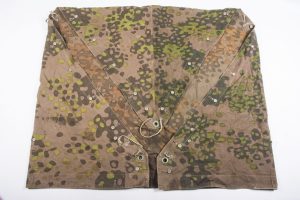
Pre war hand screened SS-VT Plane tree 5/5 with green and brown anodized buttons
Very rare 1939 dated hand screened SS-Verfügungstruppe plane tree 5/5 Zeltbahn. This pre war pattern plane tree is in very good condition and retains most if not all of its originally sewn green and brown anodized buttons. The Zeltbahn is in untouched condition and shows one stain in the middle. This is a typical stain from using when the Zeltbahn was rolled up and worn on the equipment. The Zeltbahn is nicely marked Warei Zeltbahn D.R.P. 1939 and Warei Petent Reichert Walter Reichert Berlin NW 40. Rare pre war SS-Verfügungstruppe Camouflage items are some of the rarest and most searched for items! Would be very hard to upgrade!
-
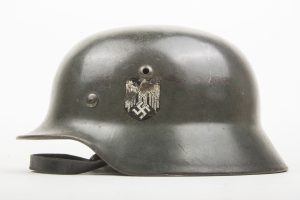
EF68 M35 double decal Heer helmet
A double decal Heer M35 helmet in minty condition. Nicely marked EF68 indicating production by Emaillierwerke Fulda. The reinforced size 61 line sits tight in the shell. The helmet still retains 90% of its original decals and paint. The helmet a nice example of a large sized textbook M35 in very good condition. A nice untouched helmet!
-
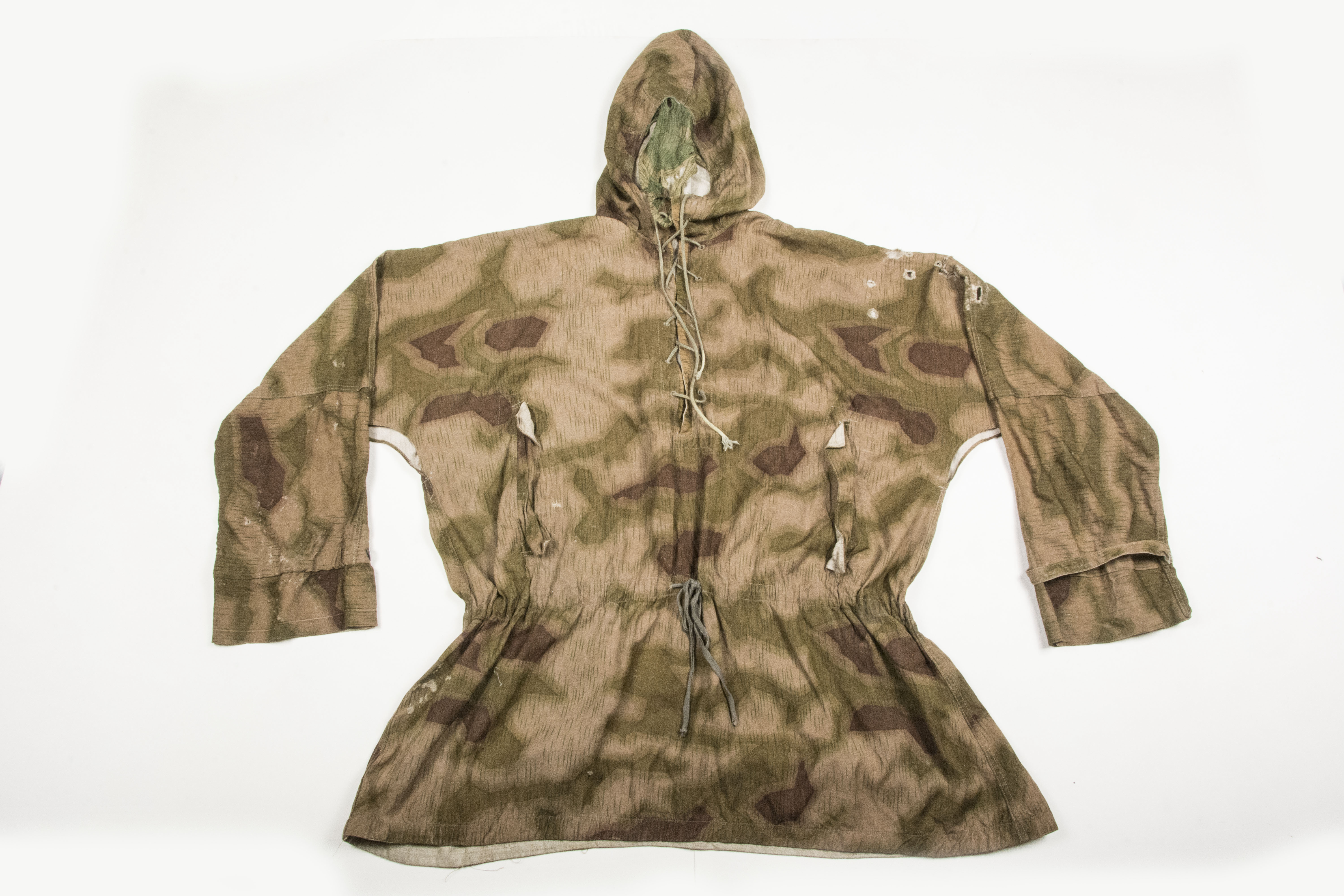
Heer/Luftwaffe hooded ’43 Sumpftarn sniper smock with veil
Nice original ’43 Sumpftarn sniper smock with face veil. Late war smock designed for wear and use by Scharfschützen in the Wehrmacht. The smock is in light worn condition and has a number of small holes which are typical for a thin garment worn in densely wooded areas. The smock is a nice large size 2 fitting most if not all mannequins. The smock is complete with both of its drawstrings and sleeve ties. A very nice surely combat worn smock with strong and vibrant colours and complete with its original face veil!
-

Spectacular M40 Heer tunic with factory sewn insignia
A stunning Heer M40 EM Feldbluse in mint/unissued condition with the original factory paper tag. The tunic is not shortened, modified or restored in any way. The dark green Litzen are factory sewn to the collar and indicate production prior to May 1940 when the grey Einheitslitzen where introduced. The breast eagle is factory machine sewn on the top, flipped and finished by hand. The picture coming after the breast eagle shot shows the stitch line, underneath the lining. The tunic has one small hole on the inside underneath the pocket, not visible from the outside. This is really a stunning textbook M40 tunic as worn and issued prior to May 1940, and possibly also worn in the 1940 campaigns!
-
ET64 M40 KIA Heer helmet in tropical DAK camouflage
Stunning single decal KIA DAK camouflage helmet in good used condition. The helmet is a so called veteran bring back from Tunis. The helmet is without liner which was most probably period removed due to severe blood stains. The inside of the helmet is corroded just like every Killed-in-Action helmet. The helmet is named inside to Sold. Hasenack Feldpostnummer 35687. The Feldpostnumber 35687 indicates use in Panzergruppen-Nachrichten-Regiment 10 which was destroyed in Tunis may 1943. The helmet is a killer example of a stunning KIA DAK helmet that would be really hard to upgrade, especially with the name and unit marking!
-
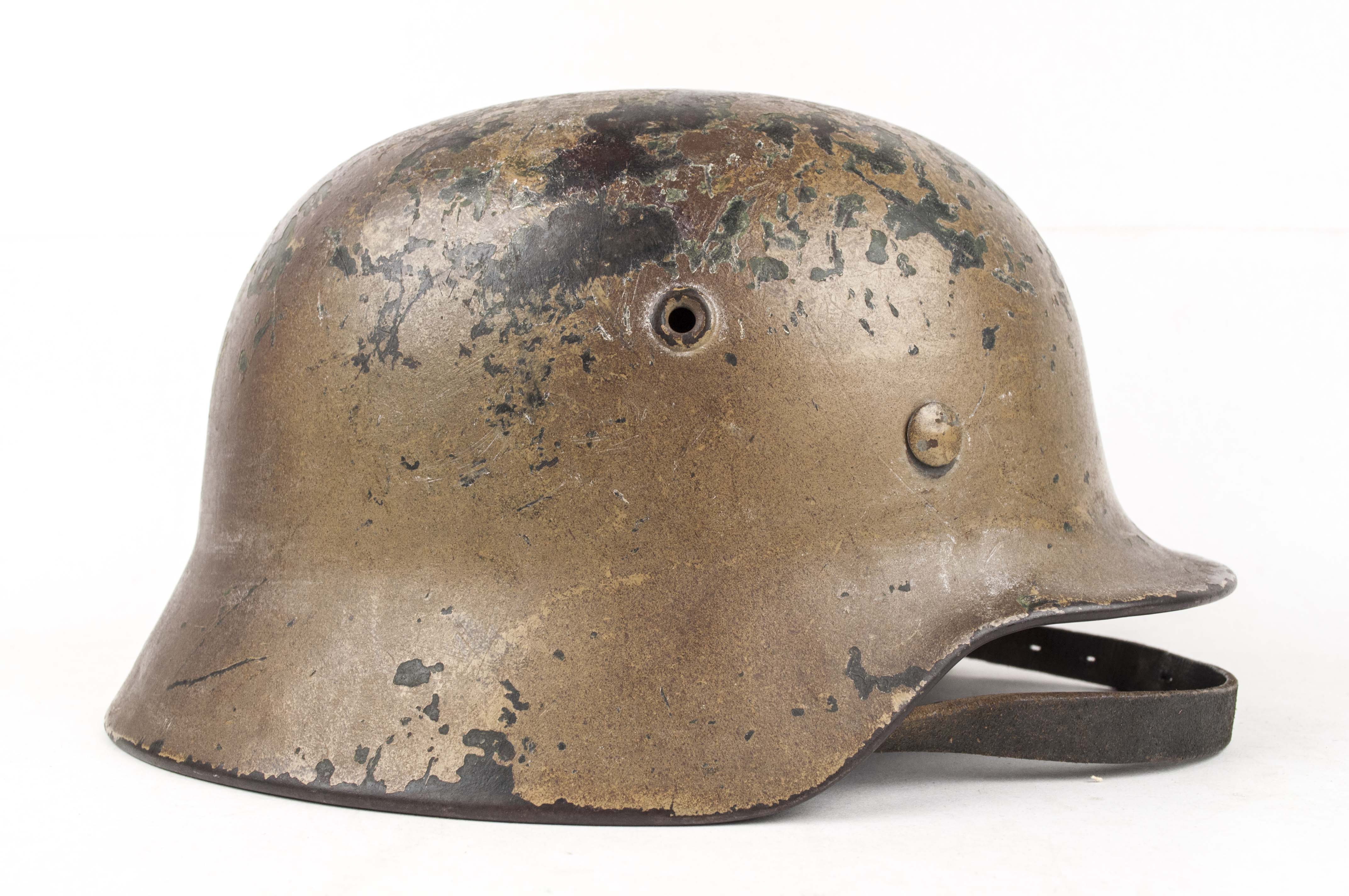
M40 ET66 In three-tone “Normandy” camouflage
A very nice original Normandy camouflage helmet in very good condition with over 85% of the original three tone camouflage remaining! See the full description for more information.
-

Stunning EF62 M40 Rautarn wire camo
A stunning original rough overpaint with wire camo helmet. The helmet has a lot of character, and a lot of interaction between the shell and the wire. This helmet is nicely named inside Pi. (Pioneer) Anton Schumatschek. The helmet has a lot of character, especially in hand. The helmet retains a rough overpaint with brown, red and green tones. The paint seems to be mixed with sand. The wire is attached to the helmet by 4 holes drilled in the shells rim. One of the nicest helmets I’ve had the chance to offer for sure!
-
Heer Infanterie officers crusher cap or Feldmütze Alter Art
Stunning example of a Heer infantry crusher, Feldmütze Alter Art or Knautschmütze. The cap is made with Dutch lining material inside which is a neat feature. These fieldcaps where incredibly popular with officers during the war. The cap is in great condition with a great patina all over. The cap can be formed to fit on a mannequin display but is otherwise folded flat as a envelope. The cap is a nice size 56-57 that should fit most modern militaria mannequins. The crusher bears the Waffenfarbe of the Infanterie. These caps are getting increasingly difficult to find and this one is definitely one of the nicest ones we’ve had on offer. A great example!
-
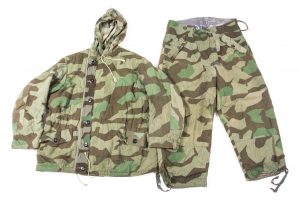
Matching set of non-reversible Splittertarn parka and trousers
Superb non-reversible Splittertarn camouflaged winter uniform set or Winteranzug 43 in light used condition with a few depot style repairs. The set is matching in material and a nice medium size which would fit perfectly on most if not all modern mannequins! Beautiful late war winter combat garment/uniform in light used condition which is hard to find!
-
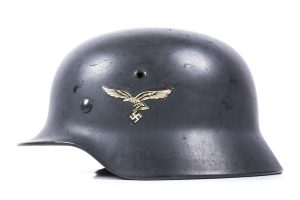
Q66 M35 double decal Luftwaffe helmet
Top shelf Luftwaffe double decal helmet marked Q66 indicating production by Quist. The helmet retains up to 95% of its minty factory finish and decals. The helme retains its factory fitted steel liner which is typical for helmets in this lot number range, also indicating it’s probably one of the last double decal helmets made. A textbook example that would be very hard to upgrade in a nice big size.
-

NS64 M42 three-tone Normandy KIA camouflage helmet
Stunning NS64 M42 three-tone Normandy camouflage helmet. The helmet is in good used condition and nicely marked NS64 with lot number D219 indicating production by Nickelwerke Schwerte. The helmet retains up to 85% of its original three-tone Normandy camouflage paint. The colours are strong and vibrant. The leather liner is original to the helmet and shows indicatory traces of blood staining indicating this a most probably a KIA helmet. The helmet is a stunning and textbook example of a three-tone Normandy camouflage helmet in great condition!
-
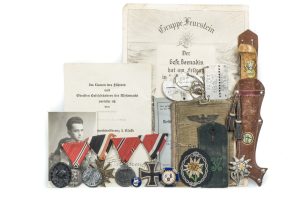
Impressive(!) grouping GBJR 137 Obergefreiter Peter Bernardin
€1,950.00Impressive Soldbuch and award grouping of Obergefreiter Peter Bernardin, 16. Panzerjäger Kompanie, Gebirgsjäger Regiment 137 where he enlisted 26.8.1939. He was issued the G.33/40 Gebirgsjäger Carbine and a pair of skis. His unit served in Poland in 1938 and after that it was sent into Norway in 1940. The unit was stationed in Lappland, Finland between 1941 and 1944. In the end of the war it was moved to the area Saarpfalz near the French border where it saw heavy action until the end of the war.
He was awarded the Medaille zum Errinnerung von 13. März 1938 on 4.5.1940, the Kriegsverdienstkreuz II klasse on 21.11.1941, the Winterschlacht im Osten on 14.12.42, the Verwundetenabzeichen im Schwarz on 17.8.43 and the Eisernez Kreuz II Klasse on 19.10.1944.
These awards are all in good condition and all have the triangular Austrian ribbon style which seems to be typical for Gebirgsjäger. The Iron Cross II class is marked 55 indicating production by J.E. Hammer & Söhne which is a rare maker as is. The wound badge is a unmarked example. The Ostmedaille is marked 6 indicating production by Fritz Zimmermann.There is a rare large document commemorating the Norway campaign in 1940 for members of Gruppe Feurstein which was named after Generalleutnant Valentin Feurstein the divisional commander of the 2. Gebirgsdivision. This document was awarded to the men who marched from Fauske to Narvik to rescue the isolated Gebirgsjäger Regiment 139. This document is named to then Gefreiter Peter Bernardin. This is a rare document!
The award document for the Kriegsverdienstkreuz II Klasse is signed by Generalmajor Ernst Schlemmer which by then was the commander of the 2. Gebirgsdivision.
Next to these official awards there is the Finnish/German Nordfront cross made by Hopeatakomo o.y. and the Petsamo Rovaniemi badge by the same maker. Both bades are in very good condition retaining most if not all of its enamel and gold coloured finish. There is also the 1943-1944 Eismeerfront capbadge with all prongs intact in the back. There is a Gebirgsjäger Edelweiss capbadge marked F&B most probably indicating production by Förster & Barth. There is a Lappland shield with this group but those are always debatable as such but I will keep it with the group. There is a traditional Finnish Puukko knife which carries the decal of the 1940 Finnish olympic games which never happened until 1952. This as such is a interesting collectible! There is a single early pointed style shoulderstrap to Gebirgsjäger Regiment 137 and a early dark green backed Edelweiss, both in uniform removed condition. His Erkennungsmarke with its original string, matching to that noted in the Soldbuch and additionally a French prisoner of war itentity tag indicating he was captured on the Western front.
This extensive grouping is exceptional. All of its individual components of a great quality and included some rare variants. The completeness of this grouping clearly deserves a separate display case and a in depth research study as such. I am sure the combined value of all the pieces individually easily increases the value of the group a lot but I refuse to break it up as a historical artifact!
-
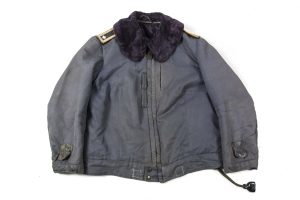
Rare Luftwaffe heated flight jacket
€1,950.00Rare Luftwaffe heated flight jacket in very good, lightly worn condition. The garment retains its electrical connectors and has a nice set of period sewn shoulderstrap loops to the shoulders. Hard to find jacket!
-
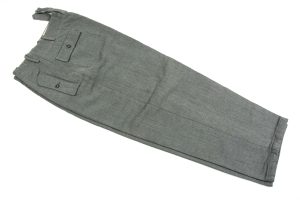
Unissued Waffen-SS M44 trousers marked Betr. Ra
Rare textbook Gaberdine Waffen-SS pattern M44 trousers in near mint condition. Nicely marked Betr. Ra. indicating production by Betriebswerk Ravensbrück (Texled). The trousers have the typical rayon string used in the end of the legs. There is one repair to the back of the trousers and some hand applied stitches inside near the leg string. Otherwise mint and unissued! Superb trousers in superb condition that would nicely match a Erbsentarn jacket!
-
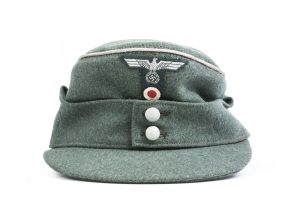
Rare Heer Gebirgsjäger EM upgraded officer Bergmütze
€1,950.00Rare Heer Gebirgsjäger enlisted men upgraded officer Bergmütze in excellent, untouched condition. Typical EM example which was wartime upgraded to the officer rank by the addition of silver piping along the top of the cap with wartime flatwire T-shape eagle. Very hard to upgrade example!
-
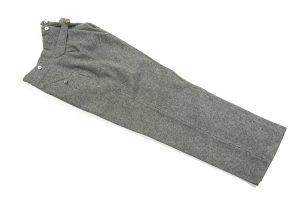
Mint M39 Steingrau Heer trousers
Mint pair of M39 trousers for use in the Heer in the Steingrauor stone grey colour. The pair retains all of its originally sewn buttons and retains 100% of the nap in the wool. The trousers are in mint condition with zero issues in a good medium size!
-
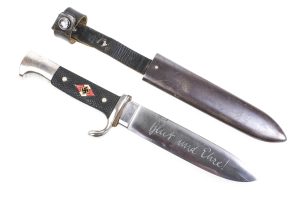
Early Hitlerjugend dagger marked J. A. Henckels Solingen Zwillingswerk Ges. Geschützt RZM M7/10 1936
Near mint, 1936 dated Hitlerjugend knife in excellent condition. The blade retains up to 99% of its perfect, spotless finish. The motto is clearly readable, the scabbard still retains its early blued finish. The leather loop is supple and it’s Stocko marked press stud is in functional condition.The knife is a near perfect example that would be very hard to upgrade. Textbook 1936 dated piece, marked J. A. Henckels Solingen Zwillingswerk Ges. Geschützt RZM M7/10. For sure a keeper!
-
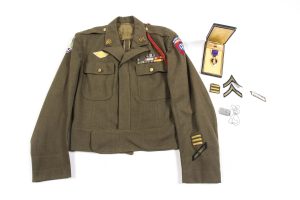
US grouping to Robert H Pederson 82nd Airborne 508 PIR
Beautiful wartime converted Class-A jacket to Ike jacket style. This grouping consists of his jacket, purple heart, dog tag, and some loose rank and service insignia. Next to that are some post war hunting licenses to Pederson. The jacket is a size 38L and comes with full wartime sewn insignia. Pederson served in the 508th Parachute Infantry Regiment during Market garden and the battle of the bulge. Nice grouping that would be a very nice base for further research!
-
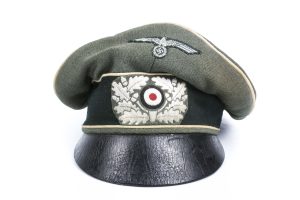
Untouched Heer Infanterie officers crusher cap or Feldmütze Alter Art
Stunning example of a untouched Heer infantry crusher, Feldmütze Alter Art or Knautschmütze. These fieldcaps where incredibly popular with officers during the war. The cap is in great, untouched condition with a great patina all over. The cap can be formed to fit on a mannequin display but is otherwise folded flat as a envelope. The cap is a nice size 57-58 that should fit most modern militaria mannequins. The crusher bears the Waffenfarbe of the Infanterie. The paper label inside the crusher is typical for the maker Viro. These caps are getting increasingly difficult to find and this one is definitely one of the nicest ones we’ve had on offer. A great example!
-
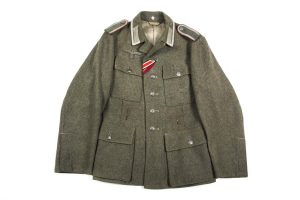
Heer NCO M43 field blouse for a Unteroffizier der Artillerie
Beautiful late war M43 Heer Feldbluse for a Unteroffizier der Artillerie. The garment is a nice, lightly worn example with wartime sewn insignia. The garment is complete with a set of period sewn award ribbons for the Eisernez Kreuz II Klasse and the Ostmedaille. There are a additional two award loops on the breast pocket. The breast eagle is a late war embroided example which has been straight and zig-zag stitched to the garment. The garment is missing one button to the collar which imo is removed so it could be easily folded. The garment is in lovely lightly worn condition with loads of character.
-
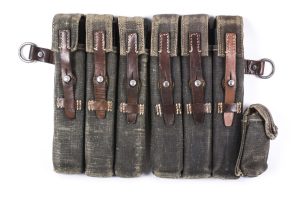
Matching MP38 u. MP40 magazine pouches
Excellent pair of matching textbook MP38 u. MP40 magazine pouches in good worn condition condition. The pouches are both matching in cloth, stitching, marking, hardware and leather. Textbook construction with several tints of leather and without modifications. The pouches are executed in nice blue canvas with brown leather. A beautiful and matching pair in good worn condition condition that would be very hard to upgrade!
-
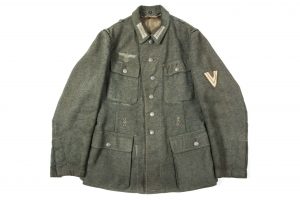
Heer M43 EM tunic in twill wool
A rare late war M43 Heer field blouse made out of rough twill wool. The tunic is nicely marked with an RBNr. 0/1297/0002. All the insignia is periodically applied, the Einheitslitzen are factory machine sewn and the breast eagle is factory sewn on the top to the garment, then flipped over and finished with a zig-zag stitch. The tunic has never been shortened or tailored but it has a few small period repairs. The tunic is a nice large size and in good used condition which would most likely fit all mannequins! Hard to find late war combat tunic made out of rough twill wool in great untouched condition which would be hard to upgrade !
-

Late war Waffen-SS Panzer M43 field cap
Textbook late war Dachau made Waffen-SS M43 cap. Textbook late war cardboard brim construction without the rear seam. The embroided Dachau trapezoid insignia is factory zig-zag sewn to the cap. The cap is in mint, unissued condition and would be very hard to upgrade!
-
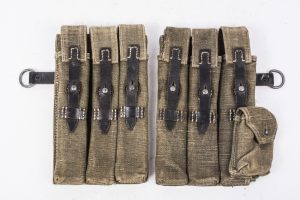
Matching pair of MP38 u. MP40 pouches by Otto Koberstein 1942
A nice matching pair of MP38 u. MP40 magazine pouches marked Otto Koberstein Landsberg 1942 indicating production by Otto Koberstein Landsberg. The pouches are in good unissued condition as pictured! The leather on the pouches is supple and the canvas is strong. One of the pouches was most probably on top hence the slight difference in aging. The set still has the original red pencil lines at all the leather fixtures. A great set for a combat mannequin that would be very hard to upgrade!
-
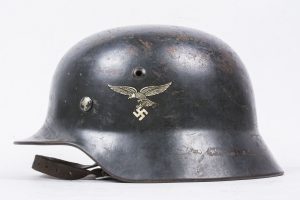
ET64 M35 Luftwaffe double decal helmet
Beautiful M35 double decal Luftwaffe helmet marked ET64 indicting production by Eisenhuttenwerke Thale. The helmet retains its factory installed reinforced aluminum liner with round aluminum chinstrap bales named Feldwebel Gasthaus. The chinstrap is a nice brown Luftwaffe issue example. The liner pins retain their washers and are period installed. The helmet comes with the early droop tail eagle and toned tricolor decal. The helmet retains up to 85% of its original factory paint and 95% of its decals. Superb early double decal helmet in very good condition!
-
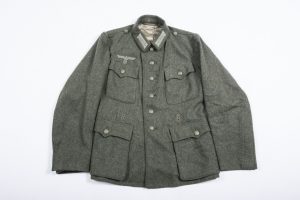
Mint Heer EM M42 tunic manufactured by Reitz
Mint and textbook M42 Heer field blouse for a enlisted men in a Infanterie- or Grenadierregiment. The garment is nicely maker marked Reitz. The garment retains all of the nap in the wool and is easily classed mint. The garment retains its original breast eagle period factory sewn zig zag through the lining and Einheitslizen. The garment has no damages, alterations or modifications and is in perfect condition. The size is a good medium fitting most if not all modern mannequins. This is a superb and mint M43 field blouse, a typical garment as issued and worn by members of the Heer in the Wehrmacht. Every detail is textbook and finding a better example would be impossible!
-

Mint condition Heer M43 field tunic
Superb original M43 field blouse for a Heer infantry EM. The tunic is mint, and retains all of its originally factory sewn insignia. The base material is a coarse Italian wool and lined with grey rayon. The size is a nice medium fitting most modern mannequins. The breast eagle is factory sewn, not through the lining. The Litzen are also factory sewn, no traces of previously sewn examples. The tunic has not been shortened or tailored in any way. The tunic has multiple size markings; the usual sizes but also a additional stamp indicating the wearers height. The original factory red chalk markings for the buttons and holes are still visible. More then likely this tunic was never ever worn! This is a superb and mint M43 field blouse, a typical garment as issued and worn by members of the Heer in the Wehrmacht. Every detail is textbook and finding a better example would be impossible!
-
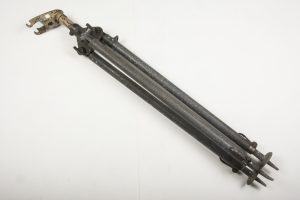
MG34 tripod Dreibein 34
Rare pre war Dreibein 34 manufactured in Electron metal. Complete with the mount for a MG34 or MG42 machine gun in its original tan finish. All three legs are fully movable and retractible. The mount and top pin are removable. These tripods are rare to find in any complete condition, this one would be perfect for a MG34 display or on the back of a Schwimmwagen!
-

Minty Heer M36 Infantry EM field blouse
Stunning EM M36 field blouse in unissued condition. The garment features its full length skirt, sleeves and waist. The wool still retains 99% of its original nap and would easily be classed as mint. The garment has one small hole in the left sleeve with a imo period repair. The insignia on the garment are original and hand sewn but in my opinion restored. On the left breast pocket a single set of loops is present for a Infanteriesturmabzeichen. The tunic has a nice early and numbered set of M36 white, wool piped infantry shoulder straps. The shoulder straps indicate use for Infanterie Regiment 51. Although the insignia are in my opinion restored this is still a very nice garment in near mint condition and very hard to upgrade. Perfect for a May 1940 display!
-

Coastal artillery type splotch camouflage helmet
Stunning 4-tone hand painted M42 helmet with battleship grey and sea green camouflage paint. The helmet is a complete untouched example with a very vibrant and stunning camouflage pattern. The helmet bears no decal but the colours are those typically seen on coastal artillery camouflage patterns such as Battleship grey and sea green. The helmet is marked NS62 indicating production by Vereinigte Deutsche Nikelwerke, Schwerte. The helmet is in very good used condition and still retains its original chinstrap and liner. The helmet would very nicely contribute to any Kriegsmarine or Kustenartillerie collection. The colours are nice and vibrant and better in hand then on the pictures!
-
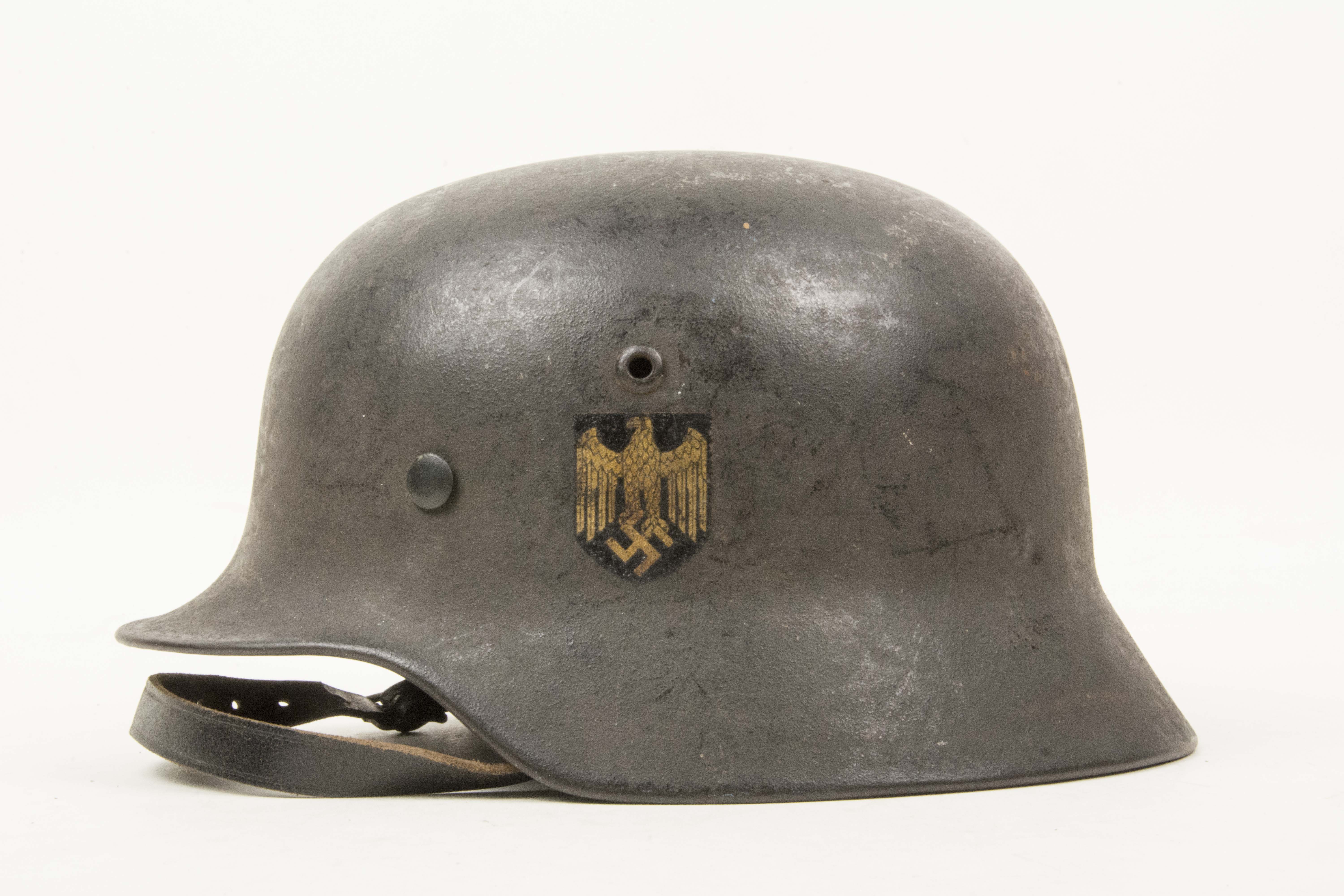
Single decal M35 SE64 Kriegsmarine helmet
Really clean example of a M35 helmet made to M40 specifications with a single Kriegsmarine decal.
The helmet still retains 99% of its factory paint and 99% of the golden Kriegsmarine decal. The helmet is marked SE64 indicating production by Sächsische Emaillier und Stanzwerke A.G. The helmet still retains its original chinstrap which is nicely maker marked and dated. In the back of the helmet the name Hohmeier and the Nordseenummer N20851M. Factory single decal M35 helmets are rare to find, specially Kriegsmarine and especially in such a nice condition! Can’t be upgraded.
-
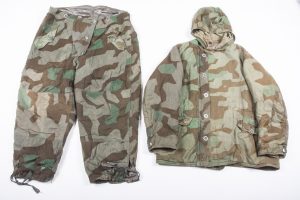
Non reversible Splittertarn parka with trousers
A very nice matching Splittertarn non-reversible wende parka with trousers marked 67. The set is a very nice combat worn example with some repairs. The garment retains most if not all of its originally sewn buttons. The jacket and the trousers are both made from a nice mix of material. The garment would make a very nice base for a Ardennes offensive mannequin!
-

Textbook Splittertarn helmet cover marked ss 204
A nice original combat worn and textbook Splittertarn cover. Nicely marked SS 204 and in good condition. The cover is photographed on a size 62 helmet shell but a size 60 would fit better. These helmet covers where issued to a lot of different units later in the war but one of the most prominent early adaptors was the Grossdeutschland division. This cover has been assembled using double and single needle sewing machines.
Scarce to find helmet cover!
-
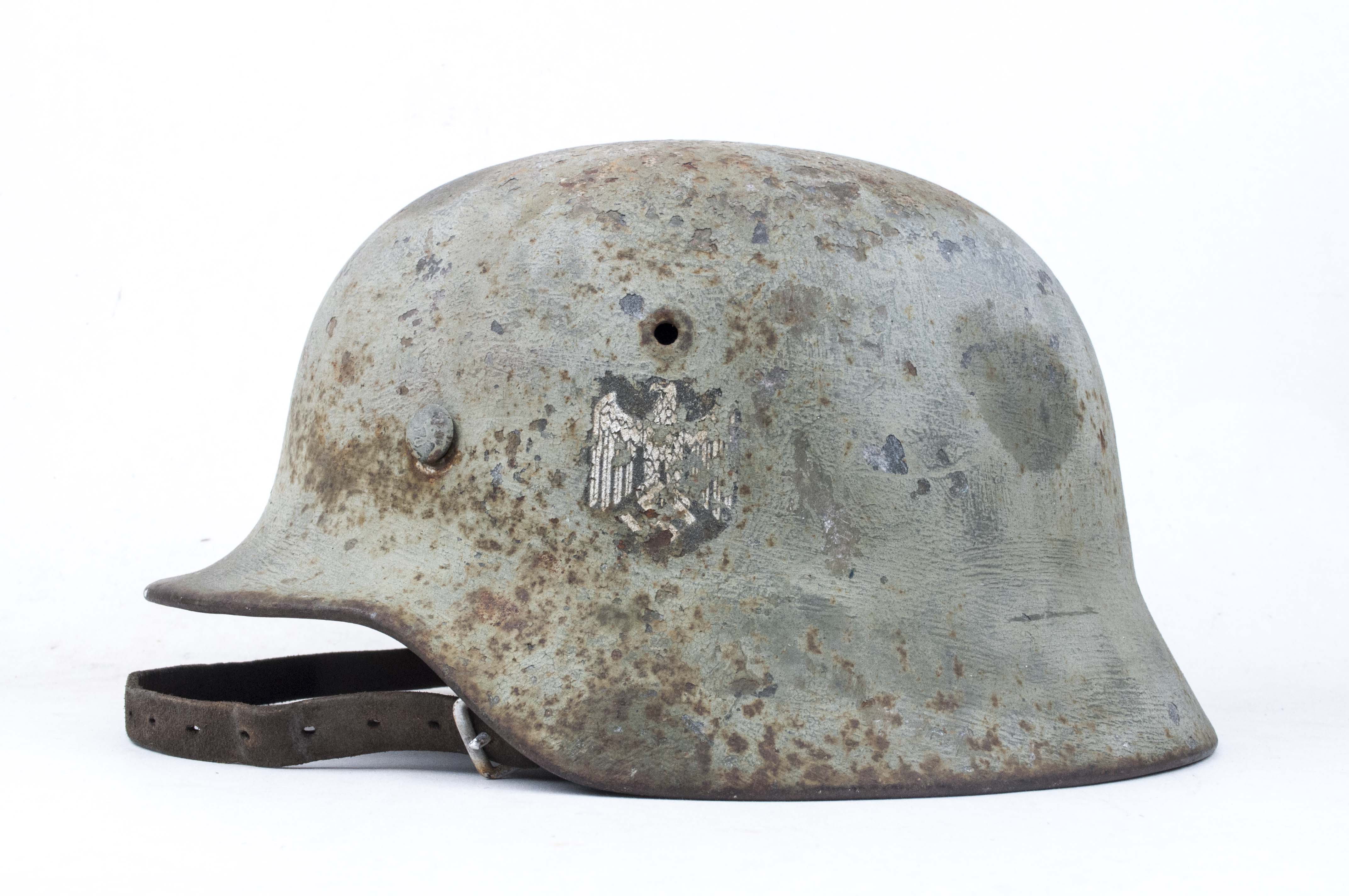
ET66 single decal Heer camouflaged M40 helmet
A great light gray camouflaged helmet in good untouched condition. The helmet retains up to 90% of its wartime camouflage paint. The helmet retains its original liner and (shortened) chinstrap. The helmet is brush camouflaged with a light gray texture paint. The helmet is named to Bleiber.
The helmet is a one-looker with lots of character!
-

Luftwaffe heated flight jacket
Rare late war Luftwaffe flight jacket in good used condition. The jacket retains its original electrical connectors and cable. The jacket is in worn condition with some repair stitching to the breast loops. Otherwise it looks in very good condition with working press studs, zippers etc. I have not tested the heating system. Uncommon late war flight jacket which would be hard to upgrade!
-
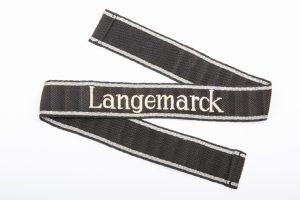
Belgian RZM pattern Waffen-SS cufftitle Langemarck
Stunning and rare cuff title for the Belgian 6. SS-Freiwilligen-Sturmbrigade Langemarck in very good condition. Nice second pattern RZM style construction. The cufftitle still retains its full length and is in very good condition. This is one of the rarest cufftitles to find in its original full length of 47,5cm.
-
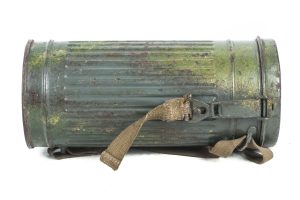
Tall M38 gasmask canister in two tone camouflage named Uffz. Janhsen
€1,900.00M38 gasmask in three tone brush applied camouflage named Unteroffizier Janhsen in very good condition. The gasmask is in a typical three-tone camouflage finish typical for this very specific unit(!). Trough the least 8 years I have seen two of this exact camouflage pattern with this Feldpost number. The lid of the spare lens compartment is marked L50830 indicating 9. Batterie Batterie Fallschirm-Flak-Regiment 12. This unit was stationed under the II. Fallschirm-Korps and was stationed in St. Lô during D-Day. This unit followed the Korps on the western front until in 1945 it moved to the eastern front. When The canister and its mask are both named Uffz Janhsen. A very nice original camouflage gasmask case with a very good base for further research into the unit!
-
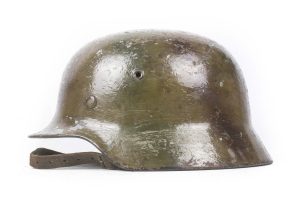
ET66 M40 Heer Ex whitewash three-tone camouflage helmet
ET66 M40 Heer Ex whitewash three-tone camouflage helmet in good condition. The helmet is a interesting example which was repainted multiple times. Starting its life as a standard single decal Heer helmet it was subsequently repainted in a winter whitewash which was later overpainted in a three-tone spray painted camouflage pattern. The helmet was at some point coated with a clear lacquer. The helmet is a nice example with a large portion of its wartime three-tone camouflage pattern showing. The helmet retains its factory installed liner. A nice example !
-
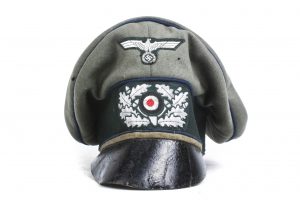
Rare Heer Sanitäter crusher cap named Dr Fr. Kortmann
Rare Heer Sanitäter crusher cap named Dr Fr. Kortmann and marked Beste Qualität. Rare original visor cap with blue piping for Sanitäter or medical troops. Hard to find Waffenfarbe in very good uncleaned condition that would be hard to upgrade!
-
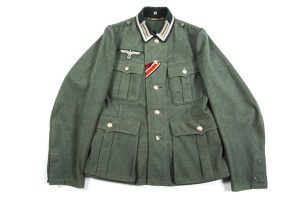
Heer NCO M35 field blouse
Rare pre war M35 field blouse wit restored breast eagle and reproduction Litzen for a Panzerjäger nco. The garment is in good worn condition with loads of character. The left breast pocket retains two period sewn award loops and the collar retains its period sewn Unteroffizierstresse. The garment is a rare pre war variant without full back lining!
Discussion on WAF; https://www.wehrmacht-awards.com/forums/forum/wehrmacht-uniforms-and-equipment/heer-uniforms-and-insignia-forum/12553514-another-panzerjäger-tunic-for-review
-
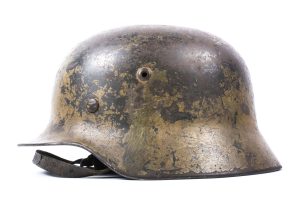
Q64 single decal Heer M35 helmet with two-tone camouflage
Untouched two-tone camouflage helmet marked Q64 indicating production by Quist. Textbook single decal M35 Heer helmet in combat worn condition. The helmet retains its factory fitted liner and chinstrap marked Franz Brehme. The helmet is a excellent and combat worn example with just the right amount of character!
-

Rare issue Ajack 4×90 sniper scope with late high turret mount
Rare original army issue Ajack 4×90 sniper scope for the K98 rifle. The scope is in good usable condition with clear sight. The scope is adjustable and comes with the originally affixed mounts. The scope is a rare original issue example and is not to be confused with a civilian rifle scope. Rare occasion to buy a real original sniper scope in good condition!
-
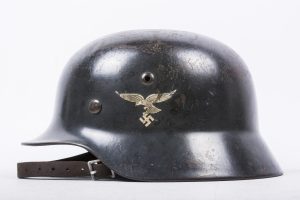
Q64 M35 Luftwaffe double decal helmet
Beautiful double decal Luftwaffe M35 helmet marked Q64 indicating production by Quist. The helmet is in good used condition with its originally placed non-reinforced liner dated 1937. The helmet is a typical pre war example with the first pattern droop tail eagle. The helmet retains up to 95% of its factory paint and decals. Nice and textbook example that would be hard to upgrade!
-
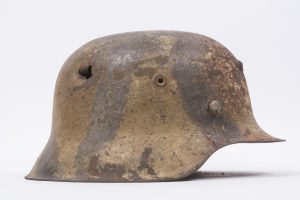
Untouched battle damaged KIA M42 camouflage helmet from Zevenbergen
Untouched M42 camouflage helmet recently found in a barn in Zevenbergen, The Netherlands. The helmet was found last december when a farmer cleared his barn in Zevenbergen and listed this and 4 other helmets on a Dutch online selling platform. Other items found where 4 helmets and 40 cases of 7,92 ammunition. The helmet was picked up short after the battles around Zevenbergen around the Moerdijk bridgehead. The helmet has a bullet or shrapnel damage to the back of the helmet which is embedded in the front of the helmet. The interior of the helmet is corroded which is a typical feature for a KIA helmet. The liner has partially rotted away due to bad storage and blood soaking. A typical KIA helmet with provenance to the Netherlands which would be hard to upgrade.
-
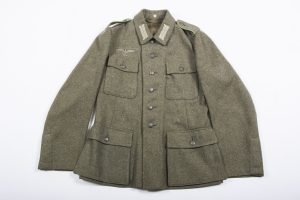
Heer Infanterie Panzergrenadier M43 field blouse with factory sewn insignia
A completely factory sewn original Heer M43 field blouse for a Grenadier in a Panzergrenadier unit. The tunic is in great nearly unworn condition. The tunic is complete with all of its period factory sewn insignia and a set of Panzergrenadier shoulderstraps. The tunic still retains 99% of its fluffy nap and shows little to no wear. This tunic has not been tailored or shortened and still retains the clean combat look. The tunic retains all of its period sewn buttons. Inside the tunic we can see a ink stain under one of the breast pockets. Most probably left by a pen in the breast pocket. Inside the shoulders it is noticable that this tunic hung in a closet on a hanger which left its mark on the lining. The tunic is a medium size which displays best, imo. This would be the centre point in a late war equipment setup!
-
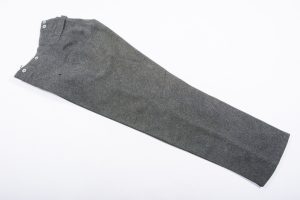
Mint M39 Steingrau Heer trousers
Mint pair of M39 trousers for use in the Heer in the Steingrau or stone grey colour. The trousers are nicely named to Unteroffizier Lehmann M Stab Panzer Abwehr Abteilung 50. The pair retains all of its originally sewn buttons and retains 100% of the nap in the wool. Guaranteed the best pair on the market today. The trousers are in mint condition with zero issues and a good big size!
-
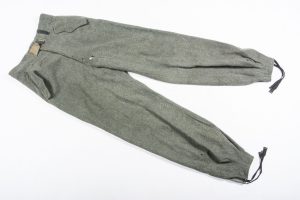
Rare Heer/Waffen-SS Sturmgeschütz trousers
Very rare original Sturmgeschütz crew trousers. Whilst the wrappers themselves are incredibly rare, only a very small percentage of the trousers survived the war. The trousers are in used condition with a number of damages to the wool. Please see the pictures to illustrate. The trousers are a perfect match to a combat used Stug wrapper. Very rare to find a original pair of Sturmgeschütz trousers!
-
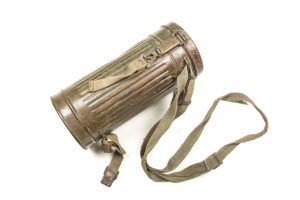
Three tone camouflage gasmask canister Uffz Pfeiffer
€1,900.00Original three-tone Normandy camouflage gasmask canister. Still retaining up to 85% of its original vibrant camouflage paint. The canister retains its original strap and mask that are original to the piece. The original wartime field applied camouflage paint retains a lot of contrast and would nicely attribute to a Normandy camouflage helmet.
Inside the lid it is named to H. Pfeiffer, a Unteroffizier in Schnell-Kampf-Geschwader 10 which was stationed in Southern Italy.
A stunning gasmask with lots of character and original camouflage. Hard to upgrade piece!
-
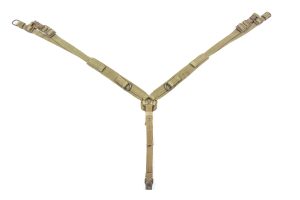
Rare first pattern tropical Y-straps named Haase
€1,875.00Rare first pattern tropical Y-straps named Haase underneath the auxiliarry strap in purple Kopierstift. The Y-straps are probably one of the rarest variants to acquire. This is a first pattern set of Y-straps with full webbing O-ring cover. The straps retain all of their original green hardware which seems to be typical and exclusive to these Y-straps. The Y-straps are made of typical olive coloured webbing and come with their original webbing backstrap. A rare opportunity to acquire a true first pattern DAK or Afrikakorps Y-strap in excellent condition!
-
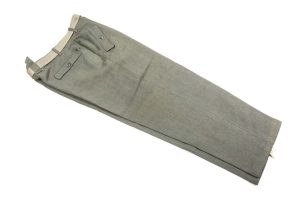
Rare Waffen-SS M44 pattern trousers
Rare textbook Gaberdine Waffen-SS pattern M44 trousers in mint condition. Excellent trousers in superb condition that would nicely match a Erbsentarn jacket!
-
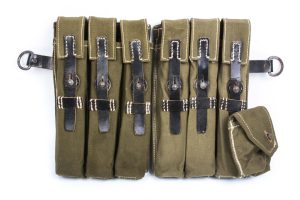
Matching pair of green MP38 u. MP40 magazine pouches marked clg 43
Excellent pair of matching green MP38 u. MP40 magazine pouches. The pouches are in mint condition and seem to be unissued. The pouches are both nicely marked MP38 u. MP40 and clg 43 which indicates production by Ernst Melzig Lederwaren, Liegnitz. Stone mint and matching pair!
-
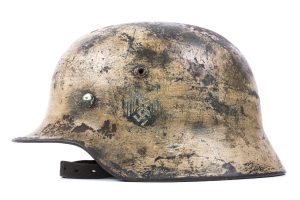
ET64 M35 Heer two tone camouflage helmet
M35 Heer helmet in two tone camouflage marked ET64 indicating production by Eisenhuttenwerke Thale. The helmet received two wartime overpaints on top of a double decal Heer factory finish. The helmet was refinished and reissued receiving a new decal and on top in brush painted tan finished with spray painted green. The helmet is in good condition retaining up to 75% of its original camouflage paint. The exterior of the helmet was cleaned at some point but retains its original finish and character. Nice original camouflage helmet that would be hard to upgrade!
Showing 601–660 of 18294 results