German helmet
Showing 14701–14760 of 17094 results
-

MP38 u. MP40 magazine pouch
Textbook MP38 u. MP40 magazine pouch in good used condition. The pouch is in good used condition!
-
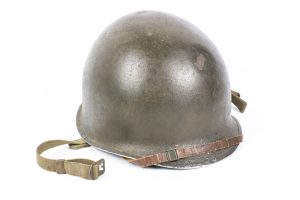
US M1 Front seam fixed bale helmet with Firestone liner
US M1 Front seam fixed bale helmet with Firestone liner in very good condition. The liner and the long outer shell strap bear several laundry numbers, making research possible. The helmet has a nice early Firestone liner with unpainted A-washers and double folded nap strap setup. A nice and honest M1 helmet in good used condition!
-
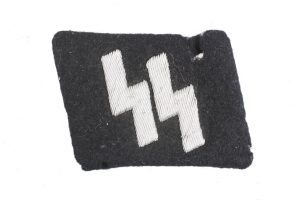
Waffen-SS bullion collar tab
Textbook Waffen-SS NCO/CO collar tab in uniform removed condition. The tab is a hand embroided bullion example with its RZM label intact on the back. Hard to find example!
-
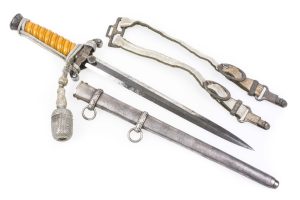
Heer officer dagger with hanger and portepee by Carl Eickhorn
€675.00No shipping out of europe!
Textbook Heer officer dagger with hanger and portepee by Carl Eickhorn in good condition.
-
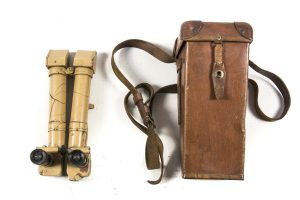
Rare tan 8×24 periscope made by Huet, Paris marked H/6400
€675.00Extremely rare factory tan painted 8×24 binoculars in good, used condition. These binoculars are a typical pattern only manufactured by the French company HUET in Paris. The largest part of these binoculars were finished in green paint, I have only encountered a few by now finished in tan paint like this one. The binoculars retain up to 85% of the original tan paint. The binoculars are in used condition but the optics are usable but not perfect. Rare French made tan coloured 8×24 binoculars in its original wartime case!
-
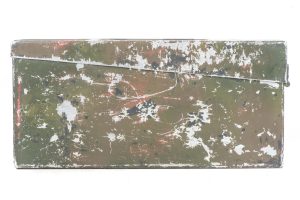
Aluminium MG34 u. MG42 ammunition case in spray painted three-tone camouflage
€675.00Aluminium MG34 u. MG42 ammunition case in spray painted three-tone camouflage. This is a pre war 1939 dated case which was factory finished in Reichswehr three tone camouflage. It was subsequently overpainted in field gray paint, later to be oversprayed in late war three-tone camouflage. The case retains up to 85% of this wartime applied camouflage paint. This case is in excellent condition and would be very hard to upgrade. A beautiful addition to any camouflage themed collection!
-
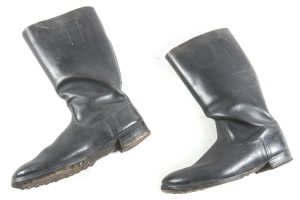
Black leather marching boots size 29 1/2
€675.00Textbook black leather marching boots size 29 1/2. This is a early high pair manufactured in black leather. The boots retain their original soles, heels and studs. The boots are in good condition and would be perfect for a combat mannequin!
-
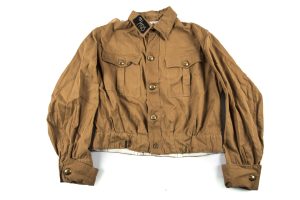
Brown SA Sturmführer blouse Berlin 12/193
€675.00Brown SA Sturmführer blouse Berlin 12/193. The blouse was saved from a cloth recycling plant and is in good, lightly worn condition. The garment retains the shoulderboard for a Sturmführer and a collar tab for the standarte Berlin 12/193. The shoulderboard and collar tab both retain remnants of their original RZM tags. The blouse is missing one button on the shoulderboard. This one has never been in a collection before.
-
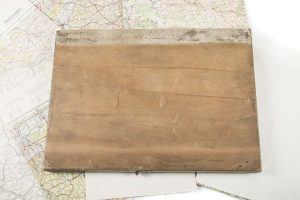
Heer map plotting board or Kartenbrett with marked maps
€675.00Heer map plotting board or Kartenbrett with marked maps in good used condition. The map board still contains its original maps that were found together. The maps mostly show Belgium and northern France. The maps are Troyes and Nancy, Mezieres and Longwy, Reims-Sens, Darmstadt. The maps are all marked with tactical markings showing the route taken by a unit entering first Belgium then northern France. In my opinion by following the route a individual unit can be assigned to the set. This is a nice set for further research and complete with its original maps attributible to the 1940 campaign!
-
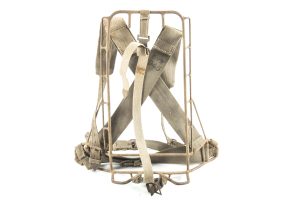
Late war tan carrying frame marked bvk 1945
€675.00Late war tan carrying frame marked bvk 1945 in good used condition. The frame is missing its horizontal straps but the vertical strap is present. Hard to find example in tan paint!
-
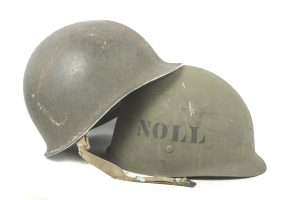
US M1 front seam fixed bale helmet with Westinghouse liner ID’ed Noll
€675.00US M1 front seam fixed bale helmet with Westinghouse liner ID’ed Noll in excellent, used condition. The helmet is a textbook fixed bale example with up to 85% of its wartime factory paint. Hard to upgrade and nicely named example!
-
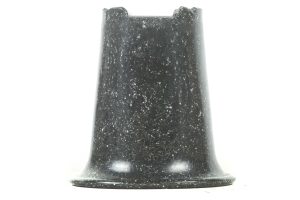
Rare white speckled canteen cup marked 46 S
€675.00Black and white speckled bakelite canteen cup marked 46 S which is a unknown manufacturer in excellent condition. This is a extremely hard to find canteen cup variant in good condition. Unlike the other coloured examples known this is the second most hard to find variant only topped with the blue speckled example which only one is known. Beautiful and rare piece!
-
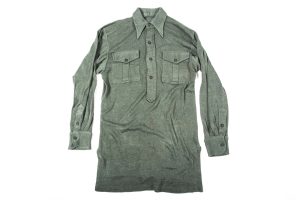
Heer/Waffen-SS pattern issue undershirt
Rare and desirable Waffen-SS/Heer waffle pattern service shirt in waffle pattern cloth. Good mannequin size and in mint condition that would be very hard to upgrade!
-
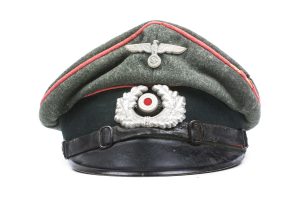
Heer Panzer EM/NCO visor
Beautiful crushed Heer Panzer EM/NCO visor in as found condition. Nice cap with a lot of character!
-
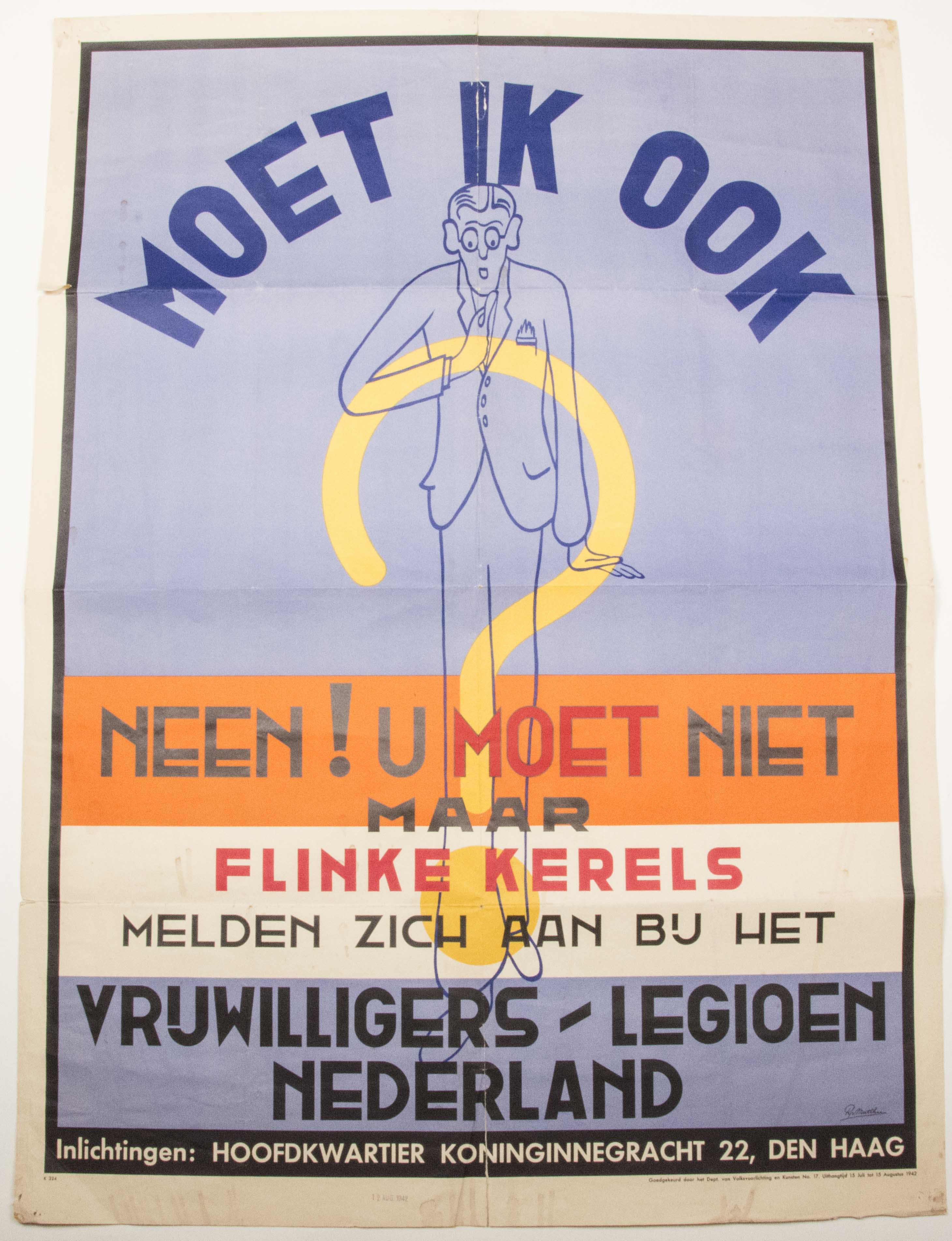
Dutch Waffen-SS poster dated 1942
Rare original Dutch Waffen-SS poster dated 1942. The poster is large (108 x80cm) and in good condition with strong colours. There are some minor damages and tears in the folds. But still a very nice original Dutch Waffen-SS poster that would very nicely display in a collection!
The poster reads: -
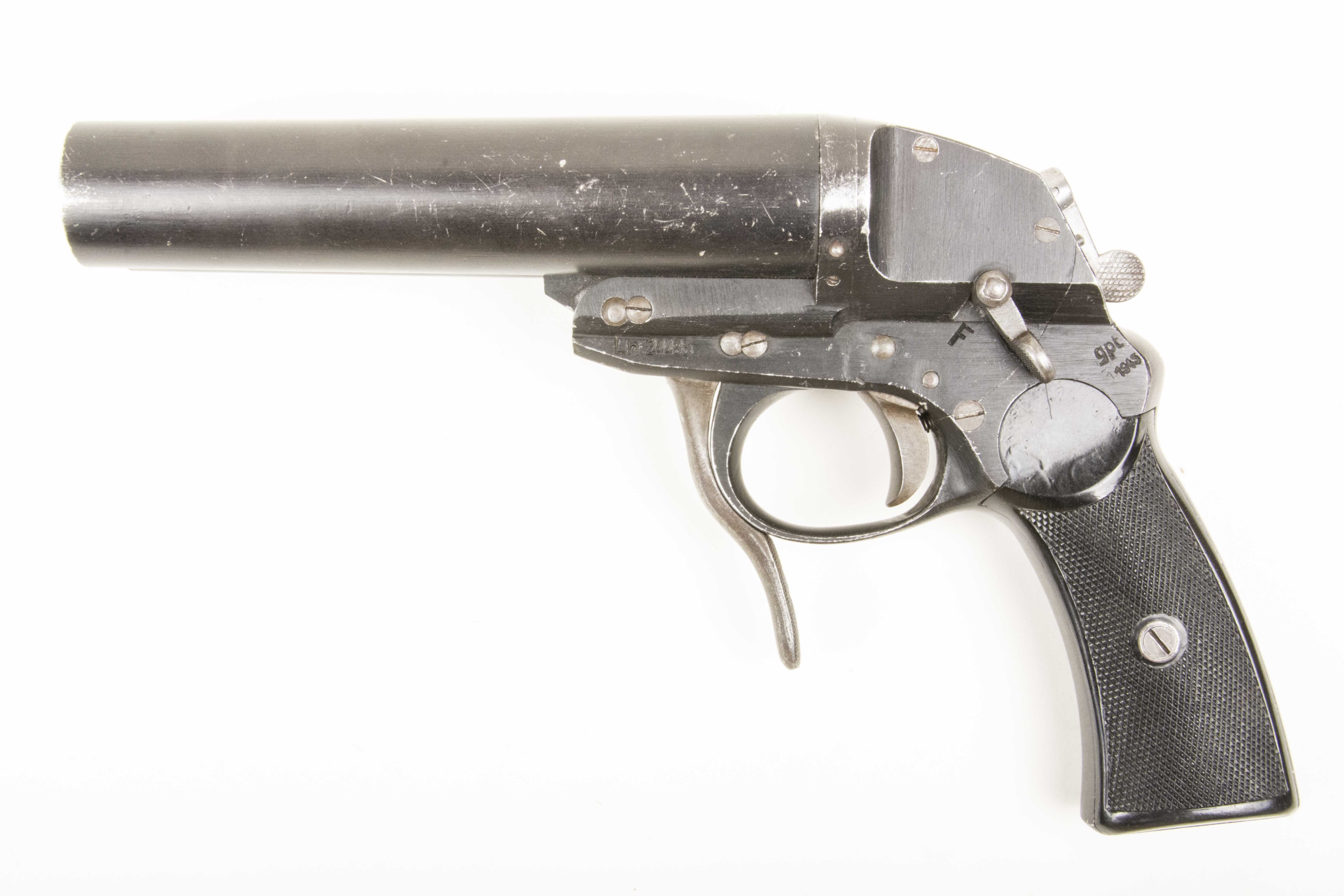
Double barreled flare gun Fliegerpistole L marked gpt 1943
A superb, near mint example of a Fliegerleuchtpistole L. These flare pistols where used by flying personnel of the Luftwaffe on missions. Nicely marked gpt 1943 indicating production by Gustav Bittner Werke. The gun can fire two flares, the left, right or both at the same time. Hard to upgrade piece, surely the best flare gun I’ve owned so far.
The flare pistol is in good working condition and free to own anyone older then 18 in the Netherlands. I will not and can not export this piece outside of the Netherlands.
-

Double barreled flare gun Fliegerpistole L marked fzs 1942
A superb, near mint example of a Fliegerleuchtpistole L. These flare pistols where used by flying personnel of the Luftwaffe on missions. Nicely marked fzs 1942 indicating production by Waffenfabrik Heinrich Krieghoff, Suhl. The gun can fire two flares, the left, right or both at the same time.
The flare pistol is in good working condition and free to own anyone older then 18 in the Netherlands. I will not and can not export this piece outside of the Netherlands.
-
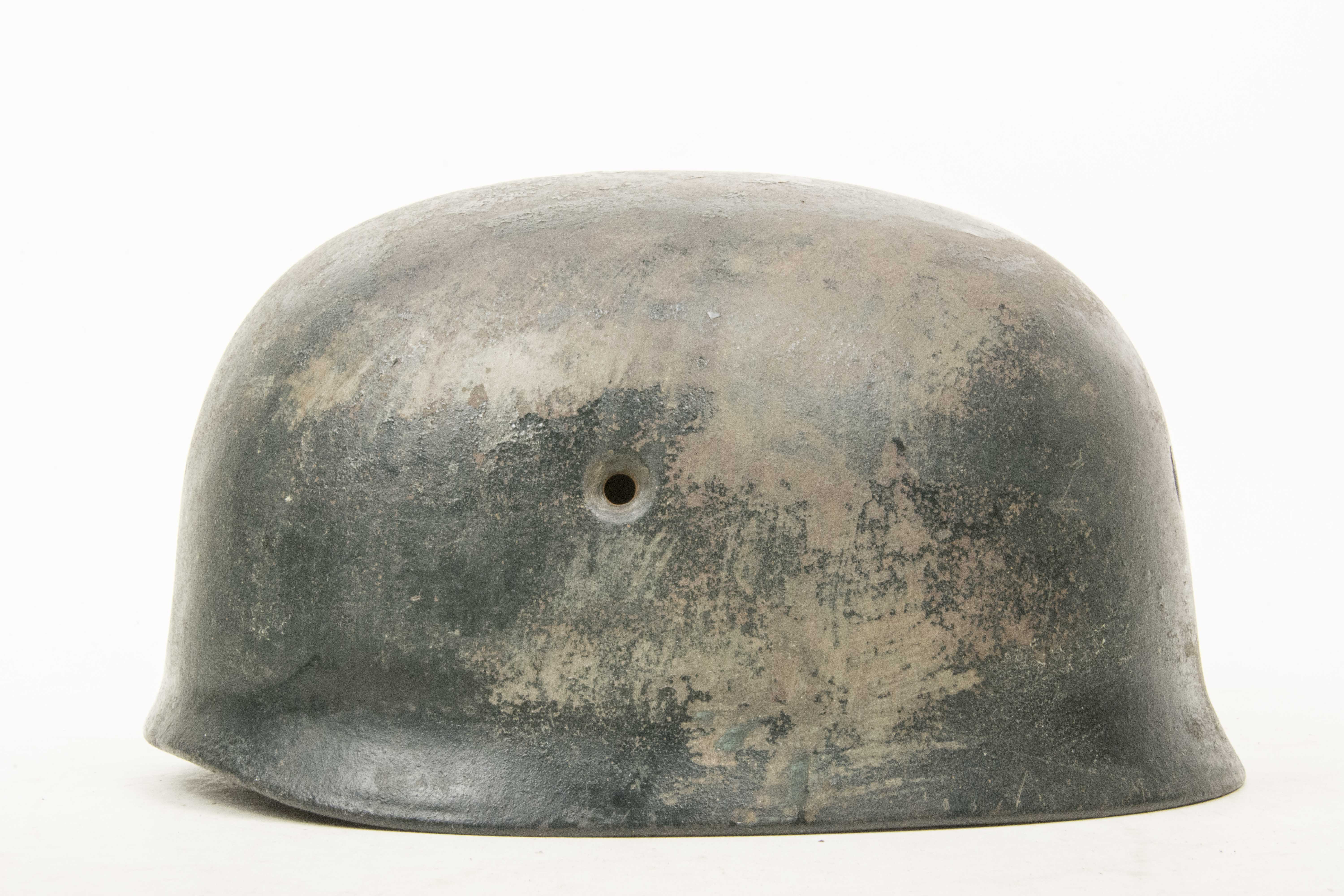
M38 paratrooper helmet shell CKL68
A very nice late war paratrooper or Fallschirmjäger helmet shell marked CKL68. The helmet is in good used condition and still retains some of its original paint. Hard to find good condition original Fallschirmjäger helmet shell!
-
Combat worn non reversible Sumpftarn parka
A very nice obviously combat worn non-reversible Sumpftarn parka in salty condition. The parka is a nice desirable size 2. The jacket has a few replaced buttons, a few holes and some obvious wear. If you’re looking for a combat jacket – this is it!
-

Steel Waffen-SS beltbuckle marked RZM 155/40 ᛋᛋ Type 4
A nice original Waffen-SS belt buckle marked RZM 155/40 ᛋᛋ indicating production by Assmann & Sohne, Lüdenscheid. The buckle is marked under the prongs which was only done for a short period in 1940. This was the final and 4th type of Waffen-SS belt buckle by Assmann in 1940. The buckle is in really good condition with most of the original paint remaining!
-
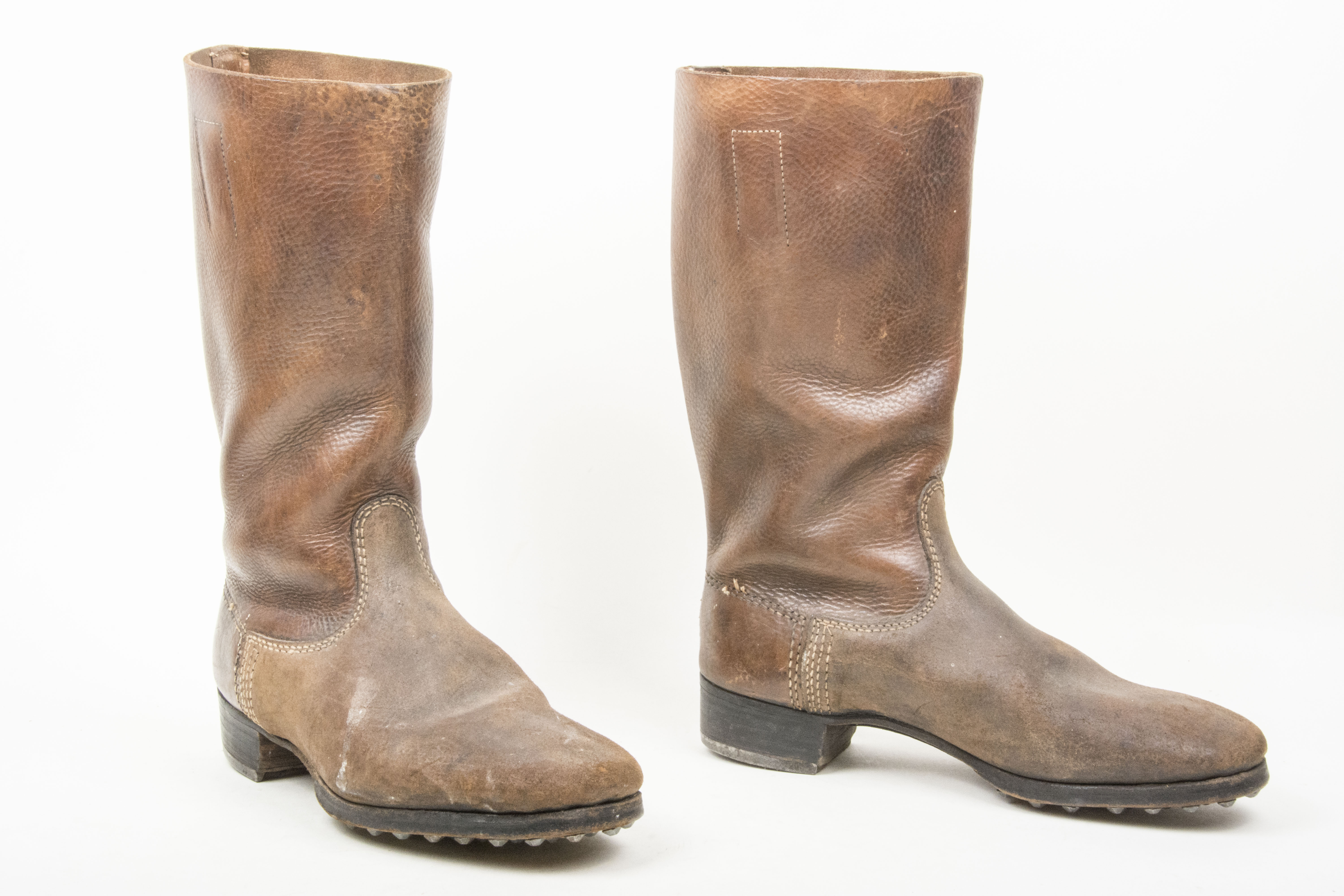
Matching pair of brown jackboots
A very nice matching pair of light brown jackboots in very good condition. A nice size 29 which would nicely fit most if not all modern mannequins. The leather is nice and supple for its age and still retains its nice light brown colour. The boots are nicely marked on the soles and around the top. The boots are hardly worn and retain all of its wartime applied metal hardware on their soles. Hard to upgrade!
-
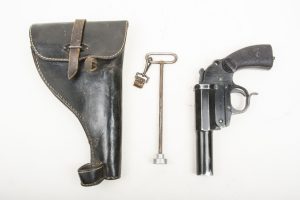
LP34 flare gun marked DUV 41 with original issue holster
Nice original LP34 flare gun with its issue holster and cleaning rod. The LP34 is marked DUV 43 which indicates production by Berlin Luebecker and is in full working condition. Complete Presstoff holster with its original cleaning rod. The pouch is nicely marked fuq 1941, and the cleaning rod is marked GL38. The set is in very good lightly used condition. Hard to find complete set!
The flare pistol is in good working condition and free to own anyone older then 18 in the Netherlands. I will not and can not export this piece outside of the Netherlands.
-
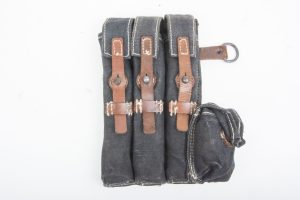
Near mint blue Luftwaffe MP38 u. MP40 pouch
Nice original MP38 u. MP40 pouch marked MP38 u. MP40. This pouch is in very good to mint condition. A very nice MP40 pouch with brown leather that would be very hard to upgrade!
-
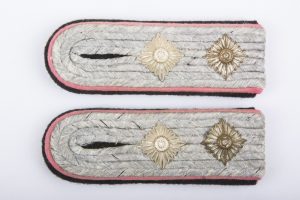
Waffen-SS Panzer shoulder boards for Hauptsturmführer
Stunning pair of Waffen-SS shoulder boards for a Hauptsturmführer der Panzertruppen u. Panzerjäger. The pair is in matching condition and shows two pairs of pips, most probably a wartime promotion. The pair is in good condition and shows very light oxidation to the metal wire.
-

Mint M43 pattern HBT or drillich combat trousers
Sale!Scarce mint condition M43 type field combat trousers in HBT or Drillich material maker marked RBNR. A nice big size for mannequins and in stone mint condition. Can’t be upgraded!
-
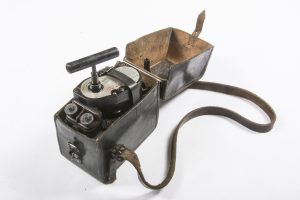
Wehrmacht Detonator type 37 or Gluhzundapparat 37
Very nice original Wehrmacht detonator or Gluhzundapparat 37 in very good, working condition. Hard to find in good working condition, complete with both keys and the tester.
-
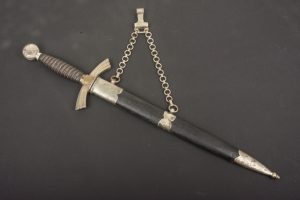
First model Luftwaffe dagger by the rare maker F. Dick
Sale!Rare first model Luftwaffe dagger by the maker F. Dick. The dagger is in as found condition with loads of patina and was recently found in household clearing in Germany. I have never encountered one of these daggers by the maker F. Dick and it is a very scarce example to obtain.
-
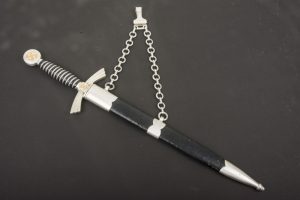
First model Luftwaffe dagger by Carl Eickhorn
Sale!Very nice first model Luftwaffe dagger by Carl Eickhorn, Solingen. The piece is constructed with aluminum details still retaining up to 99% of the silver/gold wash. The dagger is not sharpened and retains the full length unmessed with blade. The leatherette covering the sheath is still in very good condition same as the wire and grip. Superb early Luftwaffe dagger!
-
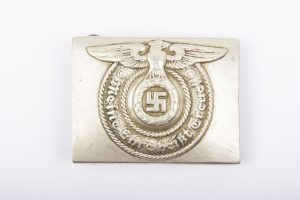
Waffen-SS cracked wing type belt buckle
A rare buckle to find in great condition! The cracked wing can be identified trough the crack in the upper left wing and head of the eagle. These buckles are unmarked and it is unclear who made these exactly. These buckles are rare to find!
-
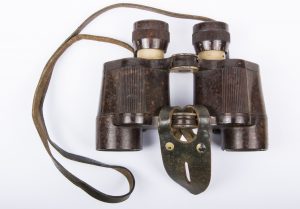
Rare bakelite 6×30 binoculars marked Dienstglas CXN
One of the rarest bits of German army equipment. A stunning pair of 6×30 Dienstglas binoculars marked CXN indicating production by Emil Busch. The binoculars have clear lenses without scratches. The binoculars still retain all of their zinc fittings and bakelite. The binoculars are nicely adjustable. They have the Strichplatte and the sight is nice to use! Two of the metal rings on the bottom are missing. They are fitted with its original strap that is affixed with two tan rivets to two sets of bales on the reverse of the main body. There is a crack in the lower hinge but the binoculars are still serviceable and look great on display! I have added two pictures of these type of binoculars in use. Bakelite binoculars can be seen on the left hand side of the picture worn by the Unterscharführer in Kampfgruppe Knittel at the Kaiserbaracke crossroads. The straps are original and exactly the type of rivets that should be on this binocular. Very nice for a late war combat mannequin!
-
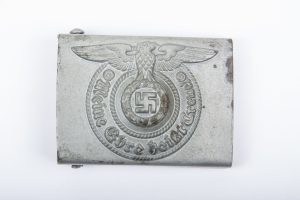
Steel Waffen-SS belt buckle marked RZM 155/43 ᛋᛋ
A very nice near mint Waffen-SS belt buckle marked RZM 155/43 ᛋᛋ indicating production by Assmann & Söhne, Lüdenscheid. This buckle, contrary to most of the production by Assmann post 1940, is finished in dull grey paint in stead of shiny silver paint. A nice and rare variation of a original Waffen-SS belt buckle with most if not all of its original finish!
-
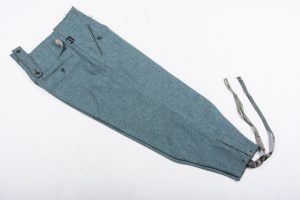
Polizei M43 Keilhosen in mint condition
A very nice mint example of a pair of Polizei M43 combat trousers or Keilhosen. In good mint condition with all its original sewn buttons. The wool is in great condition without repairs and still has most of the nap and full contrasted field grey color remaining. The trousers are in mint condition with absolutely zero issues. A great pair for a mannequin that is very hard to find in this perfect condition!
-
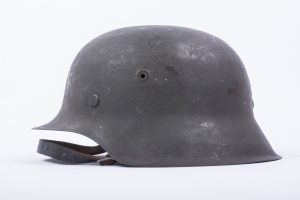
M42 EF 64 no decal helmet
A very nice M42 helmet marked EF64 in the shell size 64 indicating production by Emaillierwerke A.G., Fulda. The helmet retains its original paint and dome stamp for 99%. A nice untouched M42 helmet in near mint condition.
-
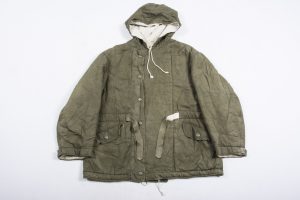
First model reversible manufactured in Wirtschaftsamt Litzmannstadt
Textbook first pattern green/grey reversible parka marked Wirtschaftsamt Litzmannstadt and dated 1942. Nice size 2, perfect for a mannequin. Very hard to find in this condition!
-
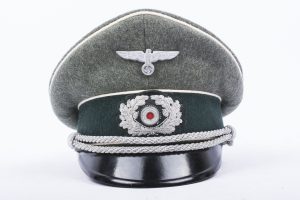
Minty Heer Infanterie officers visor
Minty officers visor for a Offizier der Infanterie. The cap is a very nice example with minty wool that really looks the way as it left the factory. The cap is free of moth damage and is easily classed near mint. The cap is a nice average size 56 fitting most modern mannequins. The cap retains its originally attached visor and chinstrap and sweatband. The rear end of the sweatband looks like its been period resewn what is pretty common with these caps. Really a stunning and minty officers visor that would be very hard to upgrade!
-
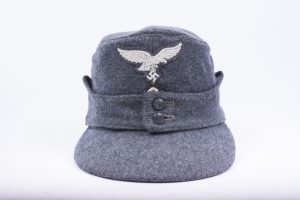
Mint M43 Luftwaffe field cap marked 0/0629/0003
Mint unissued M43 Luftwaffe field cap marked 0/0629/0003. The cap retains its factory machine sewn embroided eagle and bevy cockade. The cap is nicely dated 1944 and size marked 55. Superb condition that would be impossible to upgrade!
-
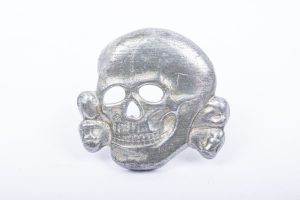
Waffen-SS metal cap skull Assmann
Rare original metal Waffen-SS cap skull by Assmann marked Ges Gesch. The eagle has both originally factory soldered prongs. Very nice original Waffen-SS cap skull in good used condition.
-
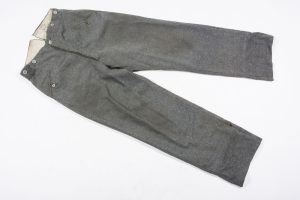
M39 Steingrau Kriegsmarine trousers
Nice pair of M39 trousers for use in the Kriegsmarine and or Küstenartillerie in the Steingrau or stone grey colour. The pair is in strong used condition and retains the Kriegsmarine acceptance stamp. The pair has a few repairs, some holes in the back and the trousers are period lengthened. A great alternative to expensive pre war Steingrau trousers!
-
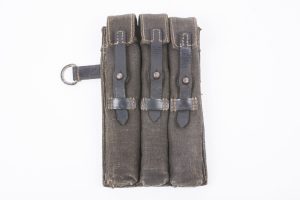
Grey MP38 u. MP40 magazine pouch
Textbook blue grey MP38 and MP40 magazine pouch for all branches in the Wehrmacht and Waffen-SS. The pouch is in good used condition and nicely ink marked on the back.
-
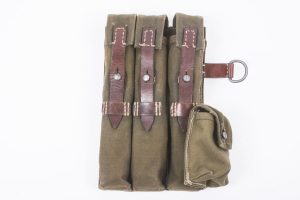
MP38 u. MP40 magazine pouch eue/43
Textbook green MP38 u. MP40 magazine pouch in very good condition. Nice mix with brown and black leather. The pouch is nicely marked eue/43 indicating production by Otto Reichel, Jnh. Rudolf Fischer, Lederwarenfabrik, Lengefeld.
-
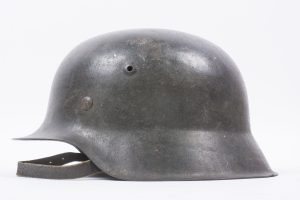
HKP64 no decal M42 helmet
A very nice M42 helmet marked hkp64 indicating production by Sächsische Emaillier und Stanzwerke A.G. in the shell size 64. The helmet retains its original paint for 95%. A nice untouched M42 helmet!
-
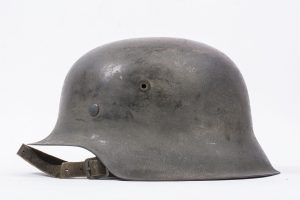
EF66 M42 no decal helmet named Uffz Römer
A very nice late war M42 helmet marked EF66 indicating production by Emaillierwerke A.G., Fulda in shell size 66 cm. The Helmet still retains up to 95% of its original textured fieldgray paint. Nicely named Uffz (Unteroffizier) Römer. These helmets where issued to all branches in the German army. The helmet complete with its original liner and chinstrap. This helmet is in very good condition and would be very hard to upgrade!
-

Steel Waffen-SS EM belt buckle by Overhoff
Textbook unmarked Waffen-SS belt buckle by Overhoff & Cie. The buckle retains up to 99% of its factory finish and would be very hard to upgrade!
-
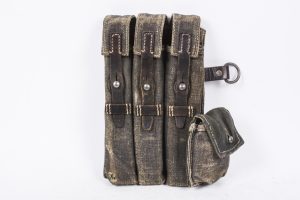
MP38 u. MP40 magazine pouch
Textbook original MP38 u. MP40 pouch in good used condition. The pouch is a typical grey canvas made example as issued to all members of the Wehrmacht which indicates the Heer, Luftwaffe and Kriegsmarine altogether. Nice original magazine pouch with the small speed loader section!
-
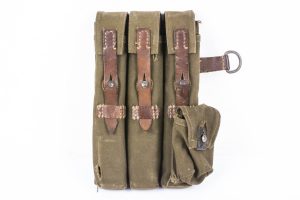
MP38 u. MP40 magazine pouch eue/43
Textbook green MP38 u. MP40 magazine pouch in good used condition. Nice mix with brown and black leather. The pouch is nicely marked eue/43 indicating production by Otto Reichel, Jnh. Rudolf Fischer, Lederwarenfabrik, Lengefeld.
-
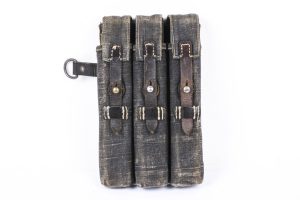
MP38 u. 40 magazine pouch marked Otto Koberstein
A great original MP38 u. MP40 pouch in good used condition. The pouch is nicely marked Otto Koberstein Landsberg 1942. A nice original MP40 ammunition pouch in very good used condition!
-
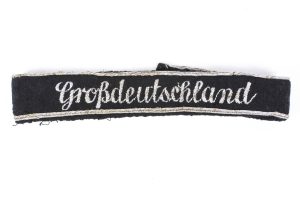
Tunic removed Großdeutschland officers cufftitle
Superb original Großdeutschland officers cufftitle in very good tunic removed(!) condition. The cuff title is very good, lightly worn condition without damages. The cufftitle is unlike many unissued cufftitles; it has clearly seen use and is tunic removed!
-

US wireless handset BC-611-C Handie Talkie 1944
Superb US handheld BC-611-C Wireless set in unissued condition. The set comes with its original serial plate and fully retractible antenna. Nicely dated 1944! The set retains up to 99% of its original textbook factory crinkle paint and would be very hard to upgrade.
-
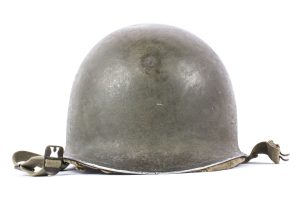
US M1 fixed bale helmet with Hawley liner named Louis E. Mertz jr.
Excellent untouched US M1 helmet with Hawley liner named Louis E. Mertz jr. The shell retains its originally sewn chinstraps and cork textured paint. The shell shows various stress cracks which are typical for this type of helmet. The helmet is in used condition with loads of character that surely makes it a typical example of a combat worn helmet.
-
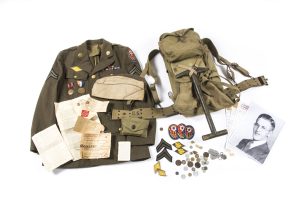
ID’ed US grouping to Med-Dept Francis D. Bigley
Large uniform and equipment grouping to Francis D. Bigley in good condition. The group consists of his Class-A jacket, small souvenirs and his equipment set. Most if not all of his items are marked with the last digits of his ASN 31410358. The equipment set consists of his complete haversack with shelter quarter, poles and stakes, T-handle shovel, meat can in pouch, the tail and all straps. The pistol belt and Carlisle first aid pack are also marked 0358. The class A-jacket is dated 1942 and named and ASN numbered. This is a great grouping that would be a good base for further research!
-
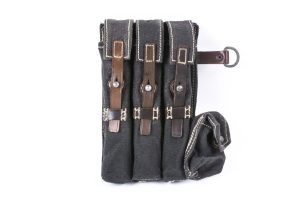
Luftwaffe MP38 u. MP40 magazine pouch
Textbook original MP38 u. MP40 magazine pouch in unissued condition. The pouch is without any damages. The pouch is a excellent Luftwaffe example with blue canvas and several colours of leather mixed which is a neat feature. The leather has been treated with a professional leather care product at some point. The pouch is a excellent and mint example that would be very hard to upgrade.
-
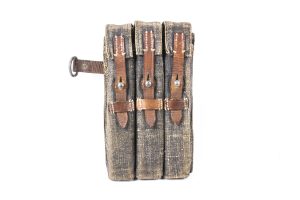
Blue Luftwaffe MP38 u. MP40 magazine pouch
Very nice original blue Luftwaffe MP38 u. MP40 magazine pouch. The pouch is in good used condition but without any damages or alterations.
-
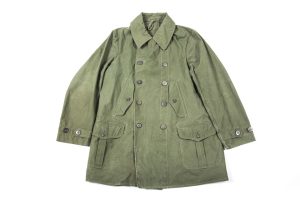
First pattern Gebirgsjäger Windjacke
Unissued first pattern Gebirgsjäger Windjacke marked C&O Dressel M37. The jacket is in very good, in my opinion unissued condition. The jacket retains all factory sewn buttons, but the loops for shoulderstraps where removed at some point. Otherwise mint and perfect, impossible to upgrade.
-
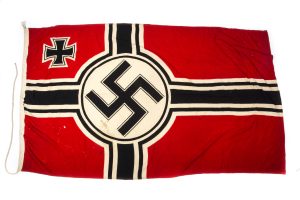
Large Kriegsmarine Reichskriegflagge
Large original Reichskriegsflagge 150×250 cm. The flag is in used condition with some holes. Nicely marked Reichskriegsflagge 150×250 with the Naval acceptance stamp.
-
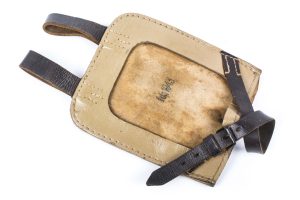
Tan straight E-tool cover marked fuq 1943
A beautiful original Tan straight E-tool cover marked fuq 1943 indicating production by Cottbusser Lederwarenwerk Curt Vogel K.G., Cottbus. The cover is in good original condition with supple leather without any issues.
-
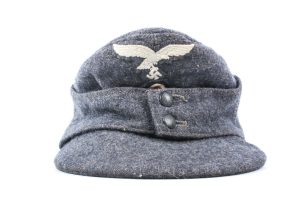
Luftwaffe M43 EM/NCO field cap marked 1944 RBNr. 0/0501/0015
A very nice Luftwaffe M43 field cap in very good condition. Marked 0/0501/0015 – 56 – 1944. A very nice one looker original M43 field cap with all original wartime applied insignia!
-
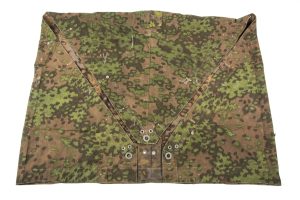
Waffen-SS Oak zeltbahn
A nice used condition Waffen-SS Oak zeltbahn, with most if not all originally sewn buttons. The Zeltbahn has a number of zig-zag depot style repairs.
-
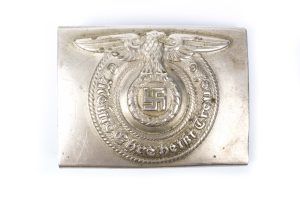
Alpaca Waffen-SS belt buckle by Overhoff
Excellent and textbook original Waffen-SS belt buckle marked O&C ges. gesch. indicating production by Overhoff & Cie, Lüdenscheid.
-
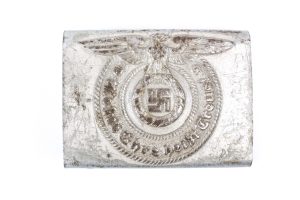
Steel Waffen-SS EM/NCO belt buckle by Overhoff & Cie
A very nice late war Waffen-SS belt buckle made by Overhoff & Cie, Lüdenscheid. These buckles where made later in the war and came unmarked. A textbook buckle in great condition still retaining up to 95% of it’s original finish!
-
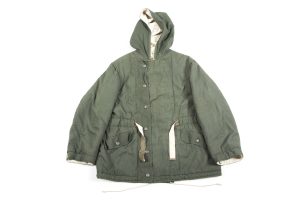
Grey reversible parka
Unissued grey reversible winter parka. The parka is a textbook example with period whitewashed white camouflage side. The garment has had some of the stitchings of the buttonholes undone; otherwise its mint and perfect and impossible to upgrade.
Showing 14701–14760 of 17094 results